 By admin
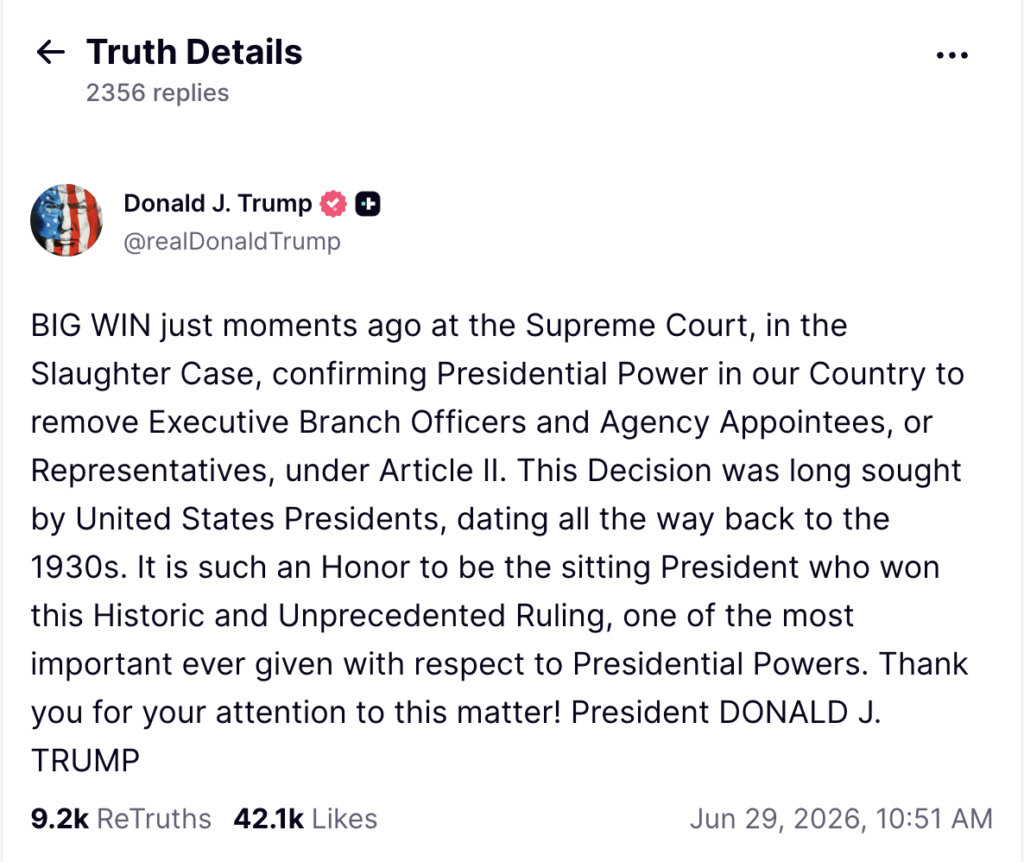
Immediately after the Supreme Court announced its decision affirming that the president could remove the heads of independent regulatory agencies at will, Trump applauded the majority. “BIG WIN,” he posted on Truth Social. “One of the most important ever given with respect to Presidential Powers.”
Read more Lawmaker warns of administration’s ‘fetishization’ of Silicon Valley startups
The Court voted 6-3, in , that the president had the legal power to fire Rebecca Slaughter in 2025 as a commissioner on the Federal Trade Commission. Although Trump sometimes is prone to exaggeration, that’s not true here. Slaughter truly is one of the most important decisions ever in expanding the president’s power, for three reasons.
1. The case established that independent regulatory commissions are no longer truly independent. Although there are only about 100 officials in independent commissions, the Slaughter decision dismantles a long hands-off tradition when it comes to presidents and their work. During Franklin D. Roosevelt’s administration, he tried to fire a member of the Federal Trade Commission, William H. Humphrey, a Herbert Hoover appointee who had been battling FDR on New Deal programs. In the hallmark case of Humphrey’s Executor – Humphrey had died, and his estate filed suit to get his back pay – the Supreme Court found that the law creating the FTC permitted the president to fire a commissioner only for “inefficiency, neglect of duty, or malfeasance in office,” and that FDR had acted illegally.
The FTC, established in 1914, followed the creation of the Interstate Commerce Commission in 1887. They were part of a string of independent regulatory commissions that emerged from the Progressive era (not to be confused with the “progressive” label applied today to left-leaning politicians). Congress made the ICC “independent” of the White House and cabinet agencies because, to be blunt, it didn’t trust the president to avoid meddling with rules trying to bring the railroad monopolies under control.
Western farmers complained that monopolists were gouging them on prices for transporting their products. Congress wanted experts to determine shipping rates and the best routes, and some of its members wanted to pull railroad cash into their own campaigns. They didn’t want the spoils system to tilt power solely to the president.
By the time Congress created the FTC, the civil service had replaced much of the traditional spoils system. Legislators wanted to make it independent like the ICC, and President Woodrow Wilson supported the idea. Since his days as a college professor, Wilson had strongly contended that “administrative questions are not political questions.” He agreed with creating staggered terms for FTC commissioners and limiting the president’s power to remove them. The Supreme Court upheld that position in Humphrey’s Executor.
Trump found himself in the same position as FDR. He wanted to remove Rebecca Slaughter from the FTC, a commissioner who he ironically had appointed during this first term, and he sent letters to her and commissioner Alvaro Bedoya saying their continued service would be “inconsistent with my Administration’s priorities.” This time, the Court agreed with the president. The independent regulatory commissions were no longer independent of the president.
2. The Supreme Court isn’t done yet. The Court is knocking on the door of an even greater expansion of the president’s power.
Slaughter advances the campaign that conservative have been waging behind the scenes to advance the “unitary executive” theory of the Constitution. The theory holds that Congress might pass laws and the Supreme Court might interpret them, but that the president has full control over the executive branch when it comes to implementing them, including the authority to fire federal employees – ultimately all federal employees – at will.
There’s no sign that the founders intended for the president to have such sweeping control over the bureaucracy because, among other things, there was no bureaucracy over which to have sweeping control. As anti-government fervor grew during the Reagan administration, however, conservatives began making the unitary executive argument with far more fervor. Since then, convinced that the left controlled the bureaucracy, they have been building their legal arguments to dramatically increase the president’s power over the bureaucracy. Slaughter marks their biggest victory yet and follows on the heels of a previous decision in 2020, Seila Law LLC v. Consumer Financial Protection Bureau, which had already chipped away at claims for agency independence.
In his concurring opinion to Slaughter, Justice Neil Gorsuch says very clearly that this is only one more step in the Court’s journey toward expanding presidential power. “It is time to return, all the way, to the Constitution,” he wrote. As he argues at length,
Read more America at 250: What the Census reveals about our journey
Open-ended delegations of legislative power have not gone away; now they will just be exercised by agency officials who answer to the President. The power to write new regulatory crimes still exists, but now the pen ultimately rests in the President’s hand. The ability to judge disputes in-house remains, but now the house is white.
The Court is sure to be back to ratify an even greater expansion of presidential power.
3. The Federal Reserve might be next. In a separate case decided the same day, the Court , a governor of the Federal Reserve. Trump had charged Cook with fraud in claiming a second home as her main residence to get a more favorable interest rate. The Court’s majority, in the 5-4 decision, said that the administration had not afforded Cook due process and could not then be removed. The administration geared up to press the facts of the case again, and several members of the Court signaled they would be willing to reconsider the ruling with a stronger case.
When Congress created the Fed in 1913, it made its policymaking independent of the president. There’s a good reason for that. Easy money and lower interest rates are always more politically popular, and Congress was afraid that political pressure might lead the Fed to drift constantly into inflation.
That’s just what happened during the Nixon administration, when the president leaned on Fed Chair Arthur Burns to loosen the money supply before the 1972 presidential election. As presidential advisor John Ehrlichman told me, soon after Nixon appointed Burns, he brought him into the Oval Office and lectured him. “You see to it: no recession,” he said. A few weeks later, Nixon told Ehrlichman and advisor Bob Haldeman, “The Fed must loosen—it must risk inflation.” Burns go the message and complied.
This is the stuff of the nightmares that plague Fed chairs: political pressure for easier money going into elections risks inflation that, once unleashed, becomes extraordinarily painful to control. Trump has been pressuring the Fed to lower rates leading into the congressional midterms and dismissed Cook as part of his pressure campaign. A near-majority of the Supreme Court now believes that the president ought to have the power to remove Fed governors at will, and we are tiptoeing up to an even more substantial expansion of presidential power.
4. Trump is right. In arguing that Slaughter is “One of the most important ever given with respect to Presidential Powers,” Trump is right. It pushes aside the last barrier against the president’s power to remove the heads of independent agencies with which he disagrees. That, in fact, makes the agencies no longer independent.
The decision in Cook could well extend presidential power into the most sensitive questions of economic policy. The central banks in Canada, France, Germany, Japan, and the United Kingdom all operate independently from politicians in setting their monetary policy. That could change in the US on the next case that hits the Thomas Court.
The Supreme Court is paving the road to the unitary executive approach to presidential power and, of all the actions during the Trump administration, this could well prove the most important in the long run.
Read more Lawmakers, unions and civil society groups urge withdrawal of governmentwide NDA plan