 By admin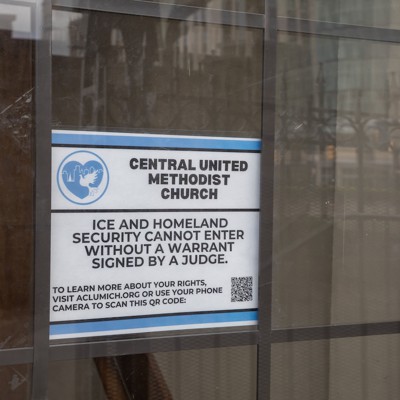
A federal appeals court Tuesday upheld an injunction that bars Department of Homeland Security agents from conducting immigration enforcement “at or near” more than 1,400 houses of worship sprawling across 33 states and the District of Columbia.
Read more The watchdog gets watched: GAO’s hiring process length faces scrutiny
The ruling by a three-judge panel of the 4th U.S. Circuit Court of Appeals upheld a February 2025 ruling in favor of a coalition of Quaker, Sikh and Baptist congregations that sued to block the Trump administration’s reversal of a Biden-era policy discouraging immigration actions at “sensitive places.”
The religious groups argued that the administration’s policy would drive away immigrant attendees, burdening “their ability to worship communally and to minister to immigrant communities, both acts of which are fundamental to their religious exercise.”
U.S. District Judge Theodore Chuang agreed, issuing the preliminary injunction in 2025 that blocked the new policy at those congregations, requiring DHS to follow the more-restrictive rules of the 2021 Biden policy. He declined to apply the injunction nationwide.
In its Tuesday, the appeals court panel upheld the injunction, agreeing with Chuang that the houses of worship were likely to succeed on their claim that the administration’s policy, if implemented, would decrease “attendance at worship services and other activities.”
“The plaintiffs have presented evidence showing that the 2025 Policy is having a chilling effect on their congregations and already has caused declines in attendance among members of CBF [Cooperative Baptist Fellowship] and the Sikh Plaintiffs,” Senior Judge Barbara Milano Keenan wrote for the court.
“And our preceding analysis makes clear that this decline in attendance and the increased threat of immigration enforcement at all the plaintiffs’ houses of worship already has imposed a substantial burden on the ability of all the plaintiffs to express their religion through communal worship,” she wrote.
Keenan noted a January 2025 statement from a Homeland Security spokesperson that she said amplified the fact that the agency “intends to target houses of worship in future immigration enforcement actions.” The judge quoted the spokesperson’s statement last year that, “Criminals will no longer be able to hide in America’s schools and churches to avoid arrest.”
“DHS’s statement emphasizing the rationale for this policy change shows that the threat of immigration enforcement at their houses of worship is real and substantial,” wrote Keenan, who was joined by Judges Pamela Harris and G. Steven Agee.
When asked for a response to the ruling Tuesday, a Homeland Security spokesperson replied with a paraphrase of that 2025 statement.
“Criminals are no longer able to hide in places of worship to avoid arrest. The Trump Administration will not tie the hands of our brave law enforcement and instead trusts them to use common sense,” the statement said.
It went on to say that Immigration and Customs Enforcement “does not target places of worship. This is just another false narrative to try and demonize our brave ICE law enforcement who are facing” increased assaults and death threats.
Read more USDA hasn’t looked at staff attrition ahead of relocations, but downplays its impact
But Democracy Forward, the Washington, D.C.-based group that filed the lawsuit on behalf of the houses of worship, welcomed the ruling.
“The Trump-Vance administration’s policy threatened that longstanding tradition by forcing congregations to choose between fulfilling their religious mission and protecting members of their communities,” Democracy Forward said in a statement on behalf of the plaintiffs. “We are grateful that the court has preserved these protections while this case moves forward.”
The plaintiffs include the Sikh Temple Sacramento and six yearly meetings of the Religious Society of Friends, or Quakers: from Philadelphia, New York, New England, Richmond, Baltimore and Adelphi, Md. They also include the Cooperative Baptist Fellowship, a network of hundreds of churches located in 33 states.
Their lawsuit was in response to a policy, issued on the first day of the second Trump administration, lifting restrictions on enforcement activities around sensitive locations, like schools and churches. Agents instead were told to exercise “discretion along with a healthy dose of common sense” when deciding whether to act in or around a sensitive location.
It was a change from the 2021 policy that said enforcement near sensitive areas was to be avoided “to the fullest extent possible.” Such action could still be taken but, except in emergency situations, it needed agency approval first.
Matt O’Brien, deputy executive director of the Federation for American Immigration Reform, called the 4th Circuit’s opinion “absurd.” FAIR filed a friend of the court brief in support of DHS.
“There is zero reason, constitutional or otherwise, why immigration enforcement should be prohibited near houses of worship. This is a politically-motivated decision by an activist judge.”
But in a concurring opinion, Agee noted the “narrow scope” of the preliminary injunction, which applies only to the houses of worship that sued the federal government. In essence, it doesn’t restrict Homeland Security from conducting immigration enforcement at or near sensitive places such as mental health centers, libraries, schools and other places of worship. It also doesn’t stop all activity, he wrote.
“A host of DHS immigration enforcement actions are expressly permitted by the preliminary injunction. It states, for example, that … [it] ‘does not enjoin or restrict [DHS] from conducting arrests in or near places
of worship when authorized by an administrative or judicial warrant,’” Agee wrote.
“Further … the preliminary injunction incorporates the provisions of the 2021 Policy, which itself did not ban all immigration enforcement actions at or near a place of worship,” he wrote, noting that the 2021 policy allows agents to act without prior approval when in pursuit of a suspect, when there’s a threat of violence and in other emergency situations. “Plainly, nothing in this Court’s decision or the preliminary injunction could be construed as limiting DHS’s ability to act in accord with these directives.”
Maryland Matters is part of States Newsroom, a nonprofit news network supported by grants and a coalition of donors as a 501c(3) public charity. Maryland Matters maintains editorial independence. Contact Editor Steve Crane for questions: [email protected].
Read more GSA’s Multiple Award Schedule Program: A Modern Acquisition Solution for Government Buyers